A Web of Interpretations: A Comparative Analysis of Spider-Man’s Live-Action Screen Portrayals by Tobey Maguire, Andrew Garfield, and Tom Holland (2002-2026)
Abstract
Since 2002, three actors — Tobey Maguire, Andrew Garfield, and Tom Holland — have portrayed Peter Parker / Spider-Man across three distinct live-action film cycles produced by Sony Pictures and, later, Marvel Studios. This paper offers a comparative analysis of the three eras along four dimensions: origin and production context, characterization and tonal approach, critical and commercial reception, and cultural legacy, including the actors’ historic on-screen convergence in Spider-Man: No Way Home (2021).
Drawing on trade-press reporting, box-office data, and aggregated critical scores, the paper finds that each portrayal reflects the industrial and cultural moment of its release: Maguire’s operatic, tragedy-inflected take (2002–2007) established the modern superhero blockbuster; Garfield’s more comic-accurate, romantically driven performance (2012–2014) was well received individually but undermined by studio overreach; and Holland’s youthful, ensemble-embedded portrayal (2016–present), developed within the Marvel Cinematic Universe, has achieved the greatest commercial and critical consistency of the three. The paper concludes that the character’s durability stems less from any single interpretation than from the franchise’s willingness to reinvent itself while preserving Spider-Man’s core thematic commitments to responsibility, loss, and ordinary heroism.
1. Introduction
Few characters in modern popular cinema have been rebooted as frequently, or as visibly, as Spider-Man. In the span of two decades, three different actors have played Peter Parker in three separate theatrical continuities: Tobey Maguire in Sam Raimi’s trilogy (2002–2007), Andrew Garfield in Marc Webb’s The Amazing Spider-Man duology (2012–2014), and Tom Holland in the Marvel Cinematic Universe (MCU) series beginning with Captain America: Civil War (2016). All three actors briefly shared the screen in Spider-Man: No Way Home (2021), an event that retroactively framed the three eras as complementary chapters in a single, decades-long meditation on the character rather than as competing, mutually exclusive versions.

This paper compares the three portrayals across production context, characterization, and audience and critical reception, using industry reporting and film-aggregator data as its primary evidence base. The comparison is not intended to crown a single “best” Spider-Man; rather, it treats the three performances as a case study in how a single character can be continuously reinterpreted to match the tonal expectations, technological capabilities, and commercial logics of different film eras.
2. Methodology
This is a qualitative comparative-media analysis rather than an empirical study. Characterization claims are drawn from plot synopses, critical commentary, and retrospective analyses published in film-trade and entertainment outlets. Quantitative claims about box-office performance and critical reception are drawn from Box Office Mojo–sourced reporting and the Rotten Tomatoes Tomatometer, a critic-aggregation score widely used as a shorthand indicator of a film’s critical consensus. Figures were compiled by the author from the sources cited in the References section and rendered as original charts for this paper.
3. Origin and Production Context
3.1 Tobey Maguire (2002–2007, and 2021)
Sam Raimi’s Spider-Man (2002), starring Maguire opposite Willem Dafoe and Kirsten Dunst, was produced by Columbia Pictures in association with Marvel Enterprises on a $139 million budget and grossed approximately $826.8 million worldwide, a result that helped validate the modern comic-book blockbuster as a commercial category (Wikipedia, n.d.-a). Spider-Man 2 (2004) followed with a $200 million budget and roughly $795.9 million in worldwide receipts (Wikipedia, n.d.-b), while Spider-Man 3 (2007) closed the trilogy as its highest-grossing but most critically divisive entry, earning close to $890 million worldwide despite a plot widely criticized for overcrowding its villain roster with Sandman, Venom, and the New Goblin (Forbes, 2026). Maguire reprised the role fourteen years later as an older, more emotionally settled Peter Parker in Spider-Man: No Way Home (2021).

3.2 Andrew Garfield (2012–2014, and 2021)
Following the cancellation of a planned fourth Raimi film, Sony rebooted the franchise with Marc Webb’s The Amazing Spider-Man (2012), starring Garfield opposite Emma Stone, on a budget of roughly $200–230 million; the film grossed about $758.7 million worldwide (Wikipedia, n.d.-c). Its sequel, The Amazing Spider-Man 2 (2014), expanded the villain lineup to include Electro, the Green Goblin, and Rhino, and grossed approximately $708 million worldwide against a budget of about $250 million (Yahoo Finance UK, 2026) — a profitable outcome by conventional blockbuster standards but a disappointment relative to Sony’s ambitions of launching an interconnected “Spider-Verse” of spin-off films. The franchise was shelved after the second film, clearing the way for a deal between Sony and Marvel Studios that folded the character into the MCU (Rotten Tomatoes, 2026). Garfield returned alongside Maguire in No Way Home (2021).
3.3 Tom Holland (2016–present)
Tom Holland debuted as Peter Parker in Captain America: Civil War (2016) under an agreement between Marvel Studios and Sony that placed the character inside the broader MCU continuity. His first solo film, Spider-Man: Homecoming (2017), grossed approximately $880 million worldwide (Collider, 2024a), followed by Spider-Man: Far From Home (2019), which grossed roughly $1.13 billion (CBR, 2026). Spider-Man: No Way Home (2021), which reunited Holland with Maguire and Garfield and pitted them against villains from earlier film continuities, became the highest-grossing entry in the franchise, earning close to $1.9–2 billion worldwide and ranking among the ten highest-grossing films in cinema history (Forbes, 2026; Gulf News, 2021). As of this writing, Holland is set to continue the role in Spider-Man: Brand New Day, positioning his tenure as the longest-running and commercially largest of the three (Forbes, 2026).
4. Characterization and Tonal Approach
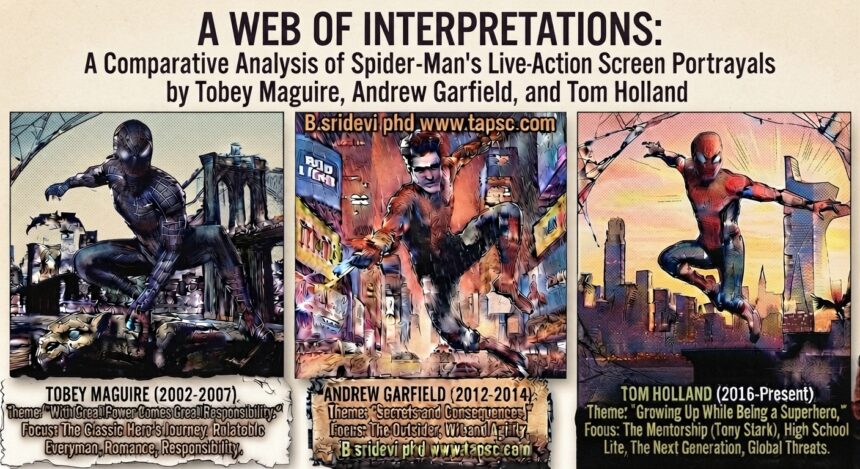
Although all three actors play the same core character — an orphaned or semi-orphaned teenager from Queens who gains spider-like powers and adopts a code of personal responsibility after the death of his Uncle Ben — the three eras diverge sharply in tone and emphasis.
Raimi’s trilogy, and Maguire’s performance within it, leans into operatic melodrama: heightened emotional stakes, tragic romance with Mary Jane Watson, and a visual language indebted to classical comic-book art and silent-film pathos. Critics have described Maguire’s Peter Parker as awkward, soulful, and prone to internal conflict, qualities that became more pronounced in Spider-Man 3 as the character is corrupted by the alien symbiote and drawn toward vengeance (Forbes, 2026).
Webb’s duology, by contrast, foregrounds a more contemporary, quip-driven take that many fans and critics have described as closer to Spider-Man’s comic-book source material, particularly in Garfield’s chemistry with Emma Stone’s Gwen Stacy and his more overtly athletic, acrobatic physical performance (Collider, 2024b). The franchise’s tonal ambition — a moodier, mystery-driven narrative involving Peter’s parents and Oscorp — was, however, frequently compromised by studio pressure to seed spin-offs, a tension widely cited as the franchise’s central weakness (Rotten Tomatoes, 2026).
Holland’s portrayal, developed inside the ensemble logic of the MCU, is the most youthful and comedic of the three, emphasizing Peter Parker’s inexperience, his mentorship under Tony Stark, and his ordinary high-school life alongside the burdens of heroism. Critics have consistently praised this take for grounding a increasingly cosmic franchise in coming-of-age stakes (Rotten Tomatoes, 2026), though some reviewers have argued that Peter’s heavy integration into the broader MCU dilutes the character’s traditional street-level independence (CBR, 2026).

5. Critical and Commercial Reception
Figure 1 compares worldwide box-office performance across all eight solo live-action films spanning the three eras. Holland’s era shows the clearest upward trajectory, driven by both the character’s integration into the MCU and the novelty of No Way Home’s multiverse crossover; Garfield’s era, by contrast, shows the franchise’s only sustained commercial decline between installments.
Figure 1. Worldwide box-office gross (in US$ millions) for each film, grouped by lead actor. Data compiled from Wikipedia (n.d.-a, n.d.-b, n.d.-c), Collider (2024a), CBR (2026), and Forbes (2026).
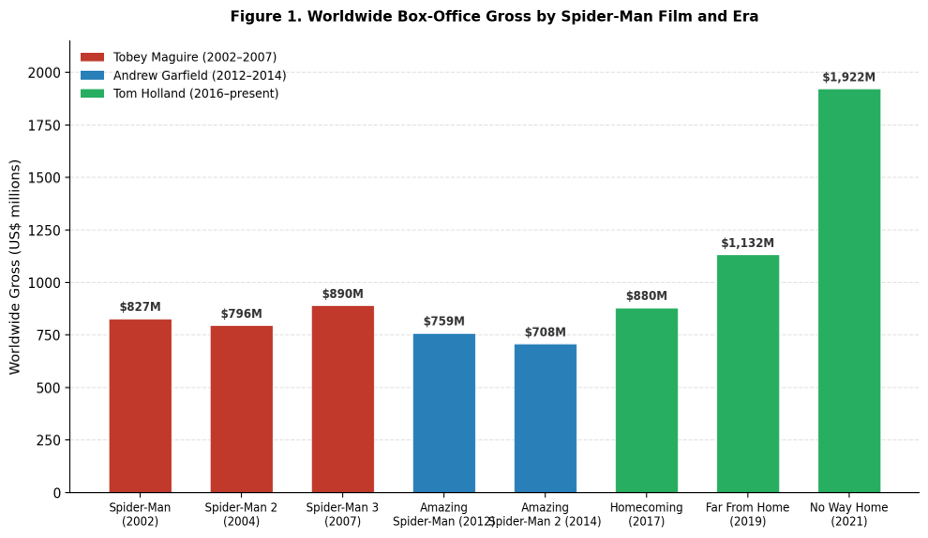
Figure 2 compares each film’s Rotten Tomatoes Tomatometer score, a critic-aggregation metric. The pattern broadly mirrors the box-office data for the Garfield era, where declining critical reception coincided with declining per-film revenue, but diverges for the Maguire era, where Spider-Man 3 remained commercially strong (Figure 1) despite a comparatively weak critical reception (66%). Holland’s three films are the most consistently well reviewed of any era, each scoring in the low-to-mid 90-percent range (FictionHorizon, 2026).
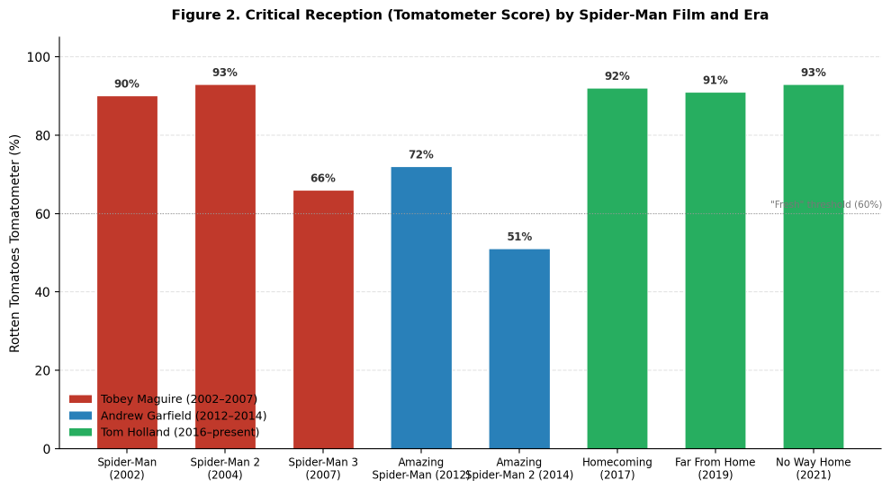
Figure 2. Rotten Tomatoes Tomatometer scores by film and era. Data compiled from FictionHorizon (2026) and Rotten Tomatoes (2026).
Notably, The Amazing Spider-Man 2 (51%) is the only entry across all three eras to fall below the Rotten Tomatoes “Fresh” threshold of 60%, a result frequently attributed in retrospective coverage to an overloaded villain roster and franchise-building subplots that came at the expense of narrative focus (Rotten Tomatoes, 2026).
6. Cross-Generational Convergence: Spider-Man: No Way Home
Figure 3 situates the three eras on a single release timeline, illustrating both the roughly five-year gap separating each reboot and the eventual convergence of all three actors in December 2021.
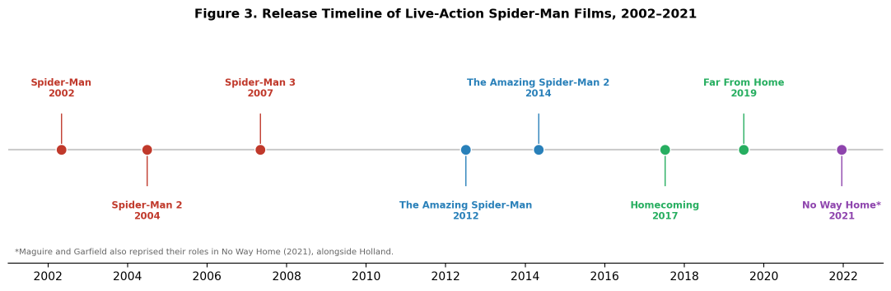
No Way Home’s multiverse premise allowed Maguire and Garfield to reprise their roles as older, more experienced versions of Peter Parker who mentor Holland’s younger incarnation, alongside the return of villains from both earlier franchises, including Willem Dafoe’s Green Goblin and Alfred Molina’s Doctor Octopus (Gulf News, 2021).
The film set records for pandemic-era box-office openings (Gulf News, 2021) and achieved a 93% Tomatometer score alongside an unusually high audience score, which ScreenRant (2021) reported as the highest in Rotten Tomatoes history at the time of release. Trade coverage has since credited the film with substantially raising audience regard for the two earlier, more divisive installments, Spider-Man 3 and The Amazing Spider-Man 2, by reframing them as chapters in a shared, generational Spider-Man mythology rather than as failed or discarded continuities (ScreenRant, 2021).
7. Cultural Legacy and Ongoing Fan Discourse
Across its eleven live-action and animated films to date, the Spider-Man franchise has grossed roughly $10 billion worldwide, a total on par with the Star Wars franchise and ahead of James Bond, Harry Potter, and Fast & Furious (Bloomberg, 2026).
This scale of success has sustained an active, ongoing fan discourse over which actor’s portrayal is “definitive,” a debate that trade press coverage suggests has no consensus resolution: Maguire’s era is frequently credited with founding the modern superhero genre, Garfield’s era is often reassessed favorably for its comic-accuracy and chemistry despite its rockier commercial run, and Holland’s era is generally recognized as the most commercially dominant and critically consistent to date (Collider, 2024b; Yahoo Entertainment, 2026).
8. Conclusion
The comparison of Maguire’s, Garfield’s, and Holland’s performances as Spider-Man illustrates how a single, well-established character can be reinterpreted to fit distinct cinematic eras without losing its essential thematic core: the tension between ordinary adolescent life and extraordinary responsibility.
Maguire’s trilogy established the character as a viable blockbuster anchor and remains critically strong outside its divisive third installment; Garfield’s shorter run delivered a well-liked lead performance undermined by studio-driven franchise overreach; and Holland’s ongoing tenure has achieved the greatest combination of critical consistency and commercial scale, aided by integration into the broader Marvel Cinematic Universe.
The 2021 convergence of all three actors in No Way Home suggests that, rather than competing for a single definitive interpretation, the character’s three screen lives are increasingly understood by audiences and critics alike as complementary variations on the same enduring story.
References
Bloomberg. (2026, August 8). From Tom Holland to Tobey Maguire: Why Spider-Man is such a box-office beast. https://www.bloomberg.com/news/newsletters/2026-08-08/from-tom-holland-to-tobey-maguire-why-spider-man-is-such-a-box-office-beast
CBR. (2026, April 22). All 3 Tom Holland Spider-Man movies are masterpieces, but one is untouchable. https://www.cbr.com/tom-holland-spider-man-trilogy-mcu-superheroes-no-way-home-list-ranked/
Collider. (2024a, August 25). All 10 Spider-Man movies, ranked by box office. https://collider.com/spider-man-movies-ranked-box-office/
Collider. (2024b, May 7). ‘The Amazing Spider-Man’ delivers lowest domestic box office haul for re-release series. https://collider.com/amazing-spider-man-rerelease-domestic-box-office-510-thousand/
FictionHorizon. (2026, July). How every Spider-Man movie stacks up according to Rotten Tomatoes scores. https://fictionhorizon.com/how-every-spider-man-movie-stacks-up-according-to-rotten-tomatoes-scores/
Forbes. (2026, July 28). Spider-Man movies in order with release dates and timeline. https://www.forbes.com/sites/entertainment/article/spider-man-movies-in-order/
Gulf News. (2021, December). ‘Spider-Man: No Way Home’ obliterates pandemic box office record. https://gulfnews.com/entertainment/hollywood/spider-man-no-way-home-obliterates-pandemic-box-office-record-1.84510257
Rotten Tomatoes. (2026, August). All Spider-Man movies ranked. https://editorial.rottentomatoes.com/guide/spider-man-movies/
ScreenRant. (2021, December 24). Spider-Man: No Way Home has highest audience score in Rotten Tomatoes history. https://screenrant.com/spiderman-no-way-home-score-rotten-tomatoes-record/
Wikipedia. (n.d.-a). Spider-Man (2002 film). Retrieved August 17, 2026, from https://en.wikipedia.org/wiki/Spider-Man_(2002_film)
Wikipedia. (n.d.-b). Spider-Man 2. Retrieved August 17, 2026, from https://en.wikipedia.org/wiki/Spider-Man_2
Wikipedia. (n.d.-c). The Amazing Spider-Man (film). Retrieved August 17, 2026, from https://en.wikipedia.org/wiki/The_Amazing_Spider-Man_(film)
Yahoo Entertainment. (2026, April 20). 3 Spider-Man movies rule streaming charts ahead of Brand New Day release. https://www.yahoo.com/entertainment/movies/articles/3-spider-man-movies-rule-125028061.html
Yahoo Finance UK. (2026, July). Every Spider-Man movie ranked by box office success. https://uk.finance.yahoo.com/news/every-spider-man-movie-ranked-090000135.html
Sridevi. B,
Ph.D Full Time Research Scholar,
Department of Library and Information Scienc