
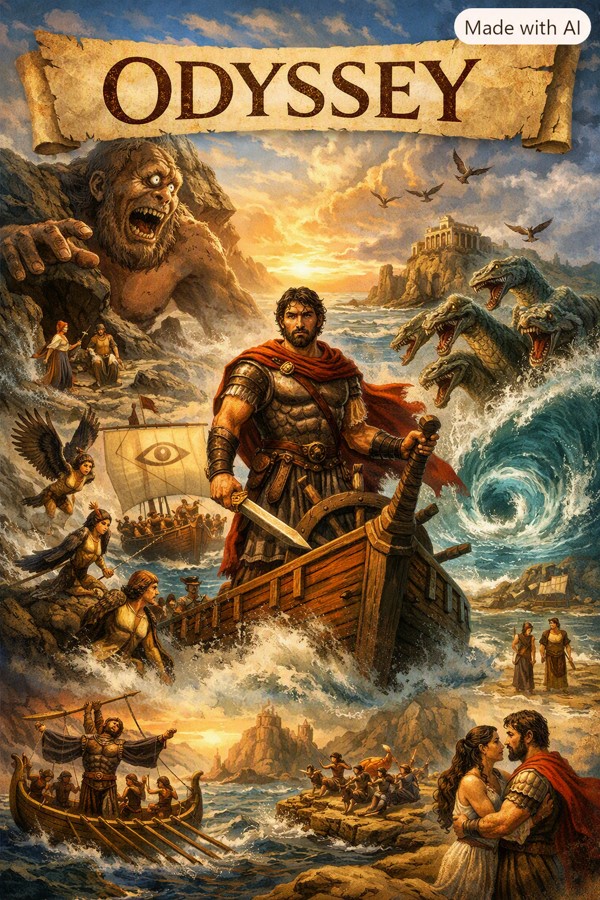
A Comparative Essay on Christopher Nolan’s The Odyssey (2026) and Homer’s Odyssey
1.Introduction
Few works of Western literature have proven as durable or as adaptable as Homer’s Odyssey, an epic poem composed roughly in the eighth century BCE that recounts the ten-year journey of Odysseus, King of Ithaca, back from the Trojan War (Homer, trans. 2018). In July 2026, director Christopher Nolan released his own version of the tale, an IMAX-scale epic starring Matt Damon as Odysseus, that became his first film since the Academy Award-winning Oppenheimer (Gosner, 2026). Because Nolan’s film was shot entirely on IMAX film cameras and cost an estimated $250 million, it represents one of the most ambitious cinematic engagements with Homeric material in recent memory (Wikipedia, 2026a). This essay compares Nolan’s The Odyssey with Homer’s Odyssey across narrative structure, characterization, treatment of the supernatural, and thematic emphasis, arguing that Nolan’s film functions less as a direct adaptation than as a psychologically grounded interpretation of the ancient epic, filtered through the director’s recurring preoccupation with fractured homecomings and the private costs of public violence.
2.Narrative Structure and Fidelity to the Source
Homer’s Odyssey is famously non-linear: the poem opens in medias res with Telemachus’s troubles in Ithaca (the ‘Telemachy’ of Books 1–4), only later following Odysseus himself, whose adventures with the Cyclops, Circe, and the Sirens are narrated retrospectively by the hero at the Phaeacian court in Books 9–12 (Homer, trans. 2018). Nolan largely preserves this layered structure but distributes the storytelling duties among several narrators rather than centring them on Odysseus alone; a bard sings of the fall of Troy to Penelope’s suitors, Eumaeus recounts Odysseus’s past to Telemachus, and Odysseus himself struggles to reconstruct his own memories in fragments (Meadows, 2026). According to one entertainment-industry summary, nearly every island visited in the poem appears on screen, including the cave of Polyphemus, the Sirens, and the strait of Scylla and Charybdis, though the Phaeacian episode on the island of Scheria — central to Homer’s frame narrative — is largely absent from the theatrical cut (Den of Geek, 2026). Figure 2 illustrates how the proportion of narrative time devoted to each movement of the story shifts between the two works, with Nolan compressing the Telemachy and expanding the flashback-driven adventure sequences to suit a roughly three-hour runtime (Fandango, 2026).
3.Characterization: Odysseus, Penelope, and Telemachus
Perhaps the most striking departure lies in Nolan’s reworking of the household dynamic between Penelope, Telemachus, and the suitors. In Homer’s text, Telemachus repeatedly asserts patriarchal authority over his mother, at one point commanding her to return to her weaving because ‘speech’ is the business of men (Homer, trans. 2018), a moment scholars read as reflecting the gender attitudes of archaic Greece. Nolan reverses this dynamic: Penelope frequently upbraids Telemachus for his immaturity and, in one added line, imagines watching the suitors burn (Variety, 2026). This change recasts Penelope from a patient, largely passive weaver into a more assertive figure who directs household affairs while her son matures under her supervision. Odysseus himself is also reframed. Rather than the boastful narrator of his own exploits in Homer’s Books 9–12, Damon’s Odysseus is depicted as a man haunted by the sack of Troy who does not relish recounting his violence (Plugged In, 2026); several reviewers describe the film’s monsters and gods as externalized manifestations of the character’s war trauma rather than literal supernatural threats (NewsGram, 2026).
4.Cast and Character Correspondence
Table 1 summarizes the correspondence between major figures in Homer’s poem and the principal cast of Nolan’s adaptation, based on official cast listings (Fandango, 2026; IMDb, 2026).



| Character in Homer’s Odyssey | Role in the Epic Poem | Actor in Nolan’s Film (2026) |
| Odysseus | King of Ithaca; narrator of his own wanderings in Books 9–12 | Matt Damon |
| Penelope | Odysseus’s wife; delays the suitors through weaving and cunning | Anne Hathaway |
| Telemachus | Odysseus’s son; comes of age searching for news of his father | Tom Holland |
| Athena | Goddess who guides and protects Odysseus and Telemachus | Zendaya |
| Calypso | Nymph who detains Odysseus on Ogygia for seven years | Charlize Theron |
| Circe | Sorceress who transforms Odysseus’s | Samantha Morton |
| crew into swine | ||
| Antinous | The most arrogant of Penelope’s suitors | Robert Pattinson |
| Helen of Troy | Former queen of Sparta whose abduction sparked the Trojan War | Lupita Nyong’o |
| Polyphemus | Cyclops son of Poseidon blinded by Odysseus | Bill Irwin |
Table 1. Correspondence between characters in Homer’s Odyssey and the principal cast of Nolan’s The Odyssey (2026).
5.Gods, Monsters, and the Supernatural
In Homer’s cosmos, gods intervene directly and visibly in mortal affairs: Athena disguises herself, redirects storms, and physically protects her favourites, while monsters such as Polyphemus, Scylla, and Charybdis are treated as literal hazards of an unmapped world (Homer, trans. 2018). Nolan retains the roster of divine and monstrous figures — Zendaya’s Athena, Bill Irwin’s Polyphemus, and the Sirens all appear in the film (Fandango, 2026) — yet several critics note that the director grounds these encounters in psychological realism, drawing inspiration from Emily Wilson’s 2017 translation of the poem and from the stop-motion aesthetic of special-effects artist Ray Harryhausen (Wikipedia, 2026a). Nolan has described the production’s approach to the sea voyages as an attempt to capture how genuinely perilous and disorienting such journeys would have felt to people navigating an uncharted world, having filmed his cast on open water across multiple countries (AOL, 2026). This grounding strategy allows the film to gesture toward myth while keeping its emotional register anchored in a single traumatized consciousness, a technique one reviewer compares to the psychological framing of Nolan’s earlier film Oppenheimer (NewsGram, 2026).
6.Key Structural and Thematic Differences
Table 2 outlines the most consequential differences between the two works identified across critical commentary on the film’s release.
| Element | Homer’s Odyssey | Nolan’s The Odyssey (2026) |
| Narrative order | In medias res; Odysseus narrates Books 9–12 himself at the Phaeacian court | In medias res; adventures are shown as diegetic flashbacks nested inside multiple tellers (a bard, Eumaeus, Odysseus) |
| Phaeacian episode | Central: Odysseus washes ashore on | Largely omitted from the theatrical cut |
| Scheria, is aided by Nausicaa, and tells his tale to King Alcinous | ||
| Telemachus–Penelope dynamic | Telemachus repeatedly asserts patriarchal authority over his mother | Roles are reversed; Penelope openly rebukes Telemachus’s immaturity |
| Treatment of violence | Graphic and celebratory descriptions of the suitors’ slaughter | Restrained; Odysseus is portrayed as haunted rather than boastful about violence |
| Monsters and gods | Presented as literal supernatural beings | Reframed in places as manifestations of Odysseus’s war trauma |
| Sexual content | Present in several episodes (e.g., Circe, Calypso) | Largely minimised or implied |
Table 2. Selected structural and thematic differences between Homer’s Odyssey and Nolan’s The Odyssey (2026).
7.Production Scale and Critical Reception
Nolan’s Odyssey distinguishes itself from prior adaptations through sheer production scale. Filming took place over 91 days across Morocco, Greece, Italy, Scotland, Iceland, Western Sahara, and Malta, making it the first blockbuster shot entirely on IMAX film cameras (Wikipedia, 2026a; AOL, 2026). Figure 1 summarizes several of the production’s key figures, including its estimated $250 million budget and its opening-weekend gross of more than $264 million globally, a figure that reportedly surpassed the opening of Oppenheimer (Gosner, 2026).
Critical response has largely characterized the film as an interpretation rather than a strict adaptation of Homer. One reviewer argues that because the Odyssey itself is a work of ‘historicized mythology’ that has been retold across civilizations for millennia, holding Nolan’s film to a standard of textual fidelity misreads what the project is attempting (Meadows, 2026). Family-oriented outlets have praised the film’s relative restraint with graphic violence and sexual content compared with both the source material and Nolan’s previous film (Plugged In, 2026), while other commentators note that the film’s episodic structure occasionally slows its momentum despite its visual ambition (NewsGram, 2026).
8.Conclusion
Christopher Nolan’s The Odyssey retains the broad architecture of Homer’s poem — its non-linear structure, its roster of gods and monsters, and its central concern with a long-delayed homecoming — while substantially reworking character dynamics, tempering the poem’s violence and sexuality, and reframing the supernatural as an extension of psychological trauma. These choices align the film with Nolan’s broader authorial preoccupations with fractured domestic return, evident across earlier films, more than with any single scholarly translation of Homer. As Meadows (2026) suggests, evaluating the film purely against the ancient text may be less productive than asking whether it succeeds as a coherent work in its own right; on that measure, critical response has been broadly, if not unanimously, favourable. Ultimately, the comparison illustrates how a three-thousand-year-old oral epic continues to be reshaped by each medium and each era that retells it, from Homer’s rhapsodes to Nolan’s IMAX cameras.
Sridevi. B,
Ph.D Full Time Research
Department of Library and Information Science,
Periyar University, Salem, Tamil Nadu, India-636011.
References :
AOL. (2026, July). Christopher Nolan shot two million feet of film on ‘The Odyssey’. AOL Entertainment. https://www.aol.com/entertainment/christopher-nolan-shot-two-million-151739354.html
Den of Geek. (2026). Christopher Nolan’s The Odyssey vs. Homer’s epic poem: What are the differences? https://www.denofgeek.com/movies/christopher-nolan-the-odyssey-vs-homer-epic-poem-the-differences/
Fandango. (2026). The Odyssey (2026) tickets & showtimes. https://www.fandango.com/the-odyssey-2026-241283/movie-overview
Gosner, W. (2026). Christopher Nolan’s The Odyssey. Encyclopaedia Britannica. https://www.britannica.com/topic/The-Odyssey-film-by-Nolan
Homer. (2018). The Odyssey (E. Wilson, Trans.). W. W. Norton & Company. (Original work composed c. 8th century BCE)
IMDb. (2026). The Odyssey (2026). https://www.imdb.com/title/tt33764258/
Meadows, F. (2026). Film review: The Odyssey (2026) [Substack newsletter]. https://fozmeadows.substack.com/p/film-review-the-odyssey-2026
NewsGram. (2026, July 29). The Odyssey (2026) review: How Nolan made the Homeric epic a spiritual sequel to Oppenheimer. https://www.newsgram.com/entertainment/2026/07/29/the-odyssey-2026-review-spiritual-sequel-to-christopher-nolans-oppenheimer
Plugged In. (2026). The Odyssey [Movie review]. https://www.pluggedin.com/movie-reviews/odyssey-2026/Variety. (2026, July 28). ‘The Odyssey’: All the ways Christopher Nolan’s movie is different from the book. https://variety.com/2026/film/news/the-odyssey-changes-christopher-nolan-adapts-homer-1236814443/
Wikipedia.(2026)The Odyssey (2026 film). https://en.wikipedia.org/wiki/The_Odyssey_(2026_film
Wikipedia. (2026b). The Odyssey (2026 movie). Simple English Wikipedia. https://simple.wikipedia.org/wiki/The_Odyssey_(2026_movie)