
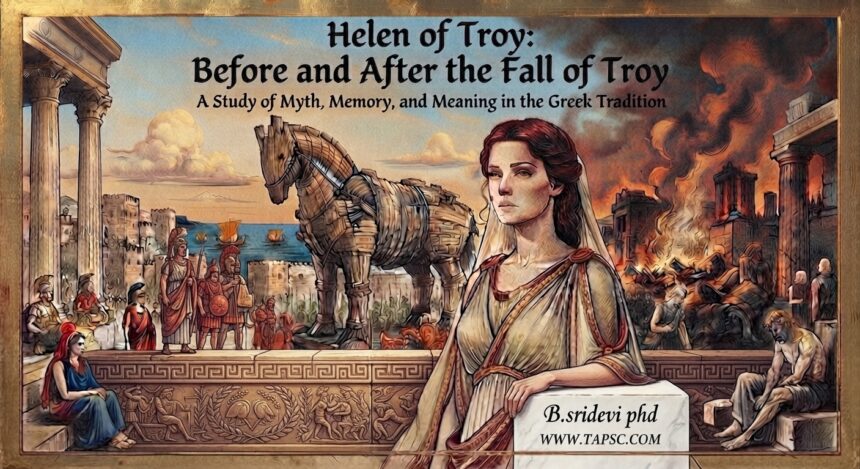
A Study of Myth, Memory, and Meaning in the Greek Tradition
Abstract
Helen of Sparta — remembered to posterity as Helen of Troy — occupies a singular place in Greek mythology as both the catalyst of the Trojan War and one of antiquity’s most contested female figures. This paper traces Helen’s mythic biography in two movements: her life before the war, as daughter of Zeus, queen of Sparta, and object of the Judgement of Paris, and her life after the war, encompassing her contested return home, her cultic afterlife as a worshipped heroine, and the divergent traditions surrounding her death. Drawing on Homeric epic, the historian Herodotus, the tragedian Euripides, and modern classical scholarship, the paper argues that Helen’s story before and after Troy reveals a figure far more complex than the passive “face that launched a thousand ships” of popular memory.
1. Introduction
Few figures in Greek mythology have generated as much interpretive controversy as Helen. Ancient authors could not agree on the most basic facts of her story: whether she went to Troy willingly or was abducted, whether she ever set foot in Troy at all, and how — or even whether — she died (Cartwright, 2021; “Helen of Troy,” n.d.-a). This instability is itself significant. Rather than treating the myth as a single fixed narrative, this paper follows classicists in reading Helen’s story as a cluster of overlapping and sometimes contradictory traditions that were reshaped by successive authors to serve their own historical and ideological purposes (Britannica, n.d.). The discussion below is organized chronologically around the Trojan War as a hinge point, examining Helen’s origins and life in Sparta before the war, and her return, cult, and death after it.
2. Before Troy: Birth, Sparta, and the Judgement of Paris
2.1 A Contested Parentage
According to the dominant tradition, Helen was the daughter of Zeus, who visited her mother Leda in the form of a swan; her mortal father, in this account, was Tyndareus, the king of Sparta (Wikipedia, n.d.-a). A rival tradition, preserved in fragments of the Cypria and later recorded by the mythographer Apollodorus, instead makes Helen the daughter of Nemesis, the goddess of retribution, whom Zeus pursued and violated in a similar act of divine shape-shifting (Discentes, 2024). Some scholars read this second tradition as a way of foreshadowing the destructive role Helen would later play, since Nemesis personified the very retribution that the Trojan War would bring upon two nations (Discentes, 2024). Helen was raised in the royal household at Sparta alongside her half-siblings Castor, Polydeuces, and Clytemnestra, and her unusual birth — in some versions she was said to have hatched from an egg — marked her as extraordinary from the outset (MYTHLAB, n.d.).
2.2 Queen of Sparta
As a young woman, Helen was already renowned as the most beautiful mortal in the Greek world, and her hand in marriage was contested by suitors from across Greece (“Helen of Troy,” n.d.-b). She married Menelaus, who thereby became king of Sparta, and the two had at least one daughter, Hermione (Wikipedia, n.d.-a). By the time Paris of Troy later arrived at the Spartan court, Helen was not a naive girl but an established queen with children and considerable political standing (Study.com, n.d.) — a detail often lost in later retellings that reduce her to a passive prize.

2.3 The Judgement of Paris
The event that set Helen’s later fate in motion took place before she ever met Paris. At a divine wedding feast, the goddesses Hera, Athena, and Aphrodite competed for a golden apple inscribed “to the fairest,” and the Trojan prince Paris was chosen to judge among them. Each goddess offered Paris a bribe; Aphrodite’s promise — that he would win the love of the most beautiful woman alive — secured her the prize (Mythopedia, n.d.). That woman was Helen, already married to Menelaus. When Paris subsequently traveled to Sparta on a diplomatic visit, this divine bargain set the stage for Helen’s departure (Mythopedia, n.d.).
2.4 Elopement or Abduction?
Ancient sources disagree sharply on whether Helen left Sparta willingly. Some accounts, including the poet Sappho, present her as leaving of her own accord, drawn by love or by Aphrodite’s influence; other traditions, including much of the visual and historiographical record discussed by Herodotus, describe her departure in terms consistent with abduction, or raptus, as ancient audiences understood that term (New World Encyclopedia, n.d.). Surviving vase painting reflects both versions: some scenes show a willing Helen, while others depict Paris seizing her by force (New World Encyclopedia, n.d.). This ambiguity — willing lover or abducted victim — is the interpretive fault line that runs through nearly every later retelling of Helen’s story, ancient and modern alike.
Figures
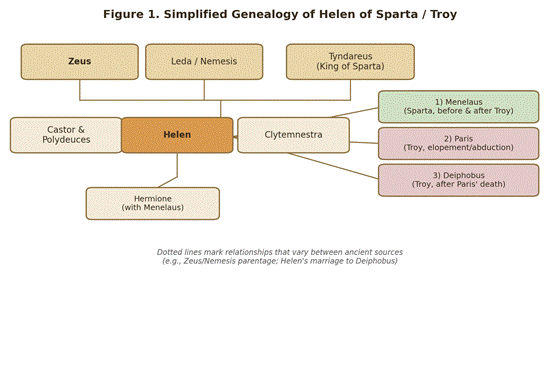
Figure 1. Simplified genealogy of Helen of Sparta/Troy, showing her divine parentage, siblings, and successive marriages before, during, and after the Trojan War.

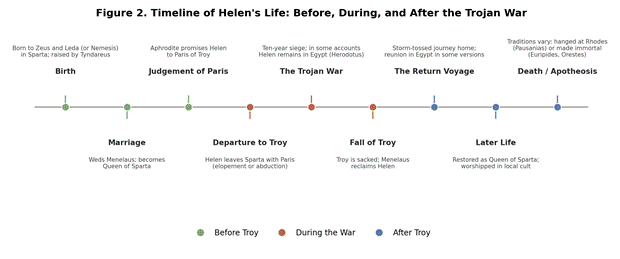
Figure 2. Timeline of the major episodes in Helen’s mythic biography, grouped into the three phases discussed in this paper: before, during, and after the Trojan War.
3. The War Years: Helen at Troy
Although this paper’s emphasis lies on the periods before and after the war, a brief account of Helen’s role during it is necessary to understand what “return” and “after” would come to mean. In Homer’s Iliad, Helen appears not as a triumphant seductress but as a guilt-ridden and largely powerless figure, resented by Trojans and Greeks alike and mourning the destruction her presence has caused (New World Encyclopedia, n.d.). After Paris was killed near the end of the war, tradition holds that Helen was married to his brother Deiphobus, whom she later betrayed to the returning Menelaus during the sack of Troy (Reid, n.d.).
A markedly different tradition, first suggested by the historian Herodotus and later dramatized by Euripides in his tragedy Helen, holds that Helen never reached Troy at all. In this version, the god Hermes spirited the real Helen away to Egypt, where she remained under the protection of King Proteus for the duration of the war, faithful to Menelaus throughout; the Helen who lived in Troy and was fought over for ten years was merely an eidolon, a phantom double fashioned by the gods (Timeless Myths, n.d.; Brewminate, 2020). Euripides used this tradition to stage a pointed meditation on the futility of war: an entire decade of slaughter, the play suggests, was fought over an illusion (R Street Institute, 2022).
4. After Troy: Return, Later Life, and Death
4.1 The Journey Home
In the Homeric account followed by the Odyssey, Menelaus reclaimed Helen amid the sack of Troy; ancient sources disagree on his intentions in that moment, with some traditions holding that he meant to kill her for her betrayal before relenting, disarmed by her beauty or her claim of divine compulsion (Britannica, n.d.; Reid, n.d.). The couple’s voyage home was far from smooth: storms scattered Menelaus’s fleet, and in several traditions the couple spent as long as eight years wandering, including a lengthy stay in Egypt, before finally reaching Sparta (Reid, n.d.). In the Egypt-focused tradition dramatized by Euripides, this detour to Egypt is instead the setting of a joyful reunion, where Menelaus at last discovers that the “real” Helen had been waiting for him all along, loyal and untouched by scandal (Timeless Myths, n.d.).
4.2 Restored Queen of Sparta
Whichever route she took, Helen is consistently said to have been restored to her position as queen of Sparta. The Odyssey depicts her there, presiding graciously alongside Menelaus when Telemachus, son of Odysseus, visits their court — a portrait of domestic harmony that stands in marked contrast to the turmoil of the war years (New World Encyclopedia, n.d.). This is the Helen of “after Troy” as most widely remembered: reconciled with her husband, once again the celebrated queen of a Greek kingdom, her wartime transgressions apparently forgiven, if not forgotten.
4.3 Death and Divinity
Traditions concerning Helen’s death are as varied as those concerning her birth. The geographer Pausanias records a tradition that Helen died at Rhodes, where, after Menelaus’s death, she was driven out by his sons and hanged from a tree by the Rhodian queen Polyxo in revenge for the war (New World Encyclopedia, n.d.). This grim episode is connected to Helen’s cult title at Rhodes, Helena Dendritis, “Helen of the Trees” (Britannica, n.d.; Grokipedia, n.d.). A very different tradition, followed by Euripides in his play Orestes, holds that Helen never died at all: she was instead taken up to Olympus and made immortal shortly after Menelaus’s return, becoming a companion of her divine brothers, the Dioscuri (New World Encyclopedia, n.d.).

These conflicting endings are not simply inconsistent storytelling; they reflect Helen’s unusual religious status. Classical scholars broadly agree that Helen was venerated as a cult figure independent of, and likely older than, her role in epic poetry (World History Encyclopedia, 2021). She was worshipped chiefly at Sparta and at Rhodes, and rituals at Therapnae associated her with the transition from girlhood to marriage, with fertility, and with beauty itself — mothers reportedly invoked her to make an unattractive child beautiful (World History Encyclopedia, 2021; Grokipedia, n.d.). At Rhodes she was linked to trees and vegetation, a role that may predate her identification with a Spartan queen at all (World History Encyclopedia, 2021). Many scholars therefore argue that the mortal, war-causing Helen of epic developed from an older local goddess whose myths of temporary “abduction” originally explained a deity’s seasonal absence from her cult sites (World History Encyclopedia, 2021).
5. Discussion: Interpreting Helen Across Two Lives
Reading Helen’s biography as a story in two parts — before Troy and after — brings into focus a consistent pattern in how ancient authors used her. Before the war, Helen functions largely as an object: a prize offered by a goddess, a queen whose beauty precipitates a conflict beyond her control. After the war, by contrast, several traditions work to restore her agency and her innocence, whether by relocating her, blameless, to Egypt for the war’s duration, or by elevating her to divine status entirely (Timeless Myths, n.d.; New World Encyclopedia, n.d.). Modern feminist scholarship has drawn attention to this pattern, arguing that Helen was persistently defined in terms of the men and events around her rather than as a character with her own interiority, even though surviving texts occasionally grant her surprising emotional and rhetorical depth, particularly in her own self-defense within the Iliad and in Euripides’ dramas (Discentes, 2024; URJ, n.d.). Contemporary retellings — from Christa Wolf’s novel Cassandra to Natalie Haynes’s A Thousand Ships — have extended this reconsideration, deliberately foregrounding Helen’s own perspective and choices rather than treating her as a passive catalyst for male violence (AncientPedia, 2024).
This reconsideration extends to the visual arts as well. From ancient vase painting through Renaissance and Baroque canvases, artists have oscillated between depicting Helen as a willing participant in her own story and as a helpless victim of abduction, a duality that mirrors the literary tradition’s own unresolved ambivalence (New World Encyclopedia, n.d.; Digital Commons SIA, n.d.). Christopher Marlowe’s line describing Helen as “the face that launched a thousand ships” (Doctor Faustus) has become the popular shorthand for her entire myth, yet it preserves only the “before Troy” Helen — beautiful, causal, silent — while erasing the equally rich traditions of her cult worship, her wartime guilt, and her contested afterlife (Britannica, n.d.; MYTHLAB, n.d.).
6. Conclusion
Helen of Troy’s story resists reduction to a single narrative arc. Before the war, she is queen, bride, and unwitting prize of a divine bargain; during it, she is by turns phantom, hostage, and guilt-stricken observer; after it, she is restored wife, venerated goddess, or tragic victim of vengeance, depending on which ancient author is followed. What unites these divergent traditions is less a fixed biography than a persistent cultural need to explain, justify, or reinterpret female beauty and agency in the aftermath of catastrophe. Read together, the “before” and “after” of Helen’s myth offer less a coherent life story than a two-thousand-year conversation about blame, forgiveness, and the limits of agency afforded to women in Greek thought — a conversation that, as modern retellings demonstrate, remains very much unfinished.
References
AncientPedia. (2024, July 20). Helen of Troy in modern culture. https://ancientpedia.com/helen-of-troy-in-modern-culture/
Brewminate. (2020, December 22). ‘Helen’: A twist on the Trojan War from Euripides. https://brewminate.com/helen-a-twist-on-the-trojan-war-from-euripides/
Britannica. (n.d.). Helen of Troy: Odyssey, story, husband, Trojan War, death, movie, & mythology. Encyclopædia Britannica. https://www.britannica.com/topic/Helen-of-Troy
Cartwright, M. (2021, January 27). Helen of Troy. World History Encyclopedia. https://www.worldhistory.org/Helen_of_Troy/
Digital Commons SIA. (n.d.). Terrible beauty: The many faces of Helen of Troy in painting from antiquity to the nineteenth century [Undergraduate thesis]. https://digitalcommons.sia.edu/stu_theses/64/
Discentes. (2024, June 16). The anatomy of a misunderstood woman: An examination of Helen of Sparta. University of Pennsylvania. https://web.sas.upenn.edu/discentes/2024/04/21/the-anatomy-of-a-misunderstood-woman/
Grokipedia. (n.d.). Helen of Troy. https://grokipedia.com/page/Helen_of_Troy
Helen of Troy. (n.d.-a). In Wikipedia. Retrieved August 17, 2026, from https://en.wikipedia.org/wiki/Helen_of_Troy
Helen of Troy: Queen of Sparta and cause of the Trojan War. (n.d.-b). Greekmythology.com. https://www.greekmythology.com/Myths/Mortals/Helen/helen.html
Helen (play). (n.d.). In Wikipedia. Retrieved August 17, 2026, from https://en.wikipedia.org/wiki/Helen_(play)
MYTHLAB. (n.d.). Episode 32: Helen of Sparta, Helen of Troy. Manto: Greek Myth Files. https://www.manto-myth.org/gmf/episode-32-helen-of-sparta-helen-of-troy
Mythopedia. (n.d.). Helen of Troy. https://mythopedia.com/topics/helen/
New World Encyclopedia. (n.d.). Helen of Troy. https://www.newworldencyclopedia.org/entry/Helen_of_Troy
Reid, [initial not available]. (n.d.). Helen [Encyclopedia entry]. Brigham Young University Old Greek Culture & Mythology Archive. https://ogcma.byu.edu/OGCMA_RoadCopy/Helen1.0000_Reid.htm
R Street Institute. (2022, November 16). The fog of war: Euripides’ Helen. https://www.rstreet.org/commentary/the-fog-of-war-euripides-helen/
Study.com. (n.d.). Helen of Troy: Story, mythology & literary reference. https://study.com/learn/lesson/helen-of-troy-story-mythology-trojan-war.html
Timeless Myths. (n.d.). Helen (Elene/Helena): Greek tragedy by Euripides, 412 BCE. https://timelessmyths.com/literature/greece/euripides/helen/
URJ. (n.d.). The bitch that launched a thousand ships: A feminist analysis of Helen of Troy and the women of antiquity. University of Colorado Colorado Springs Undergraduate Research Journal. https://urj.uccs.edu/index.php/urj/article/download/338/184/998
Sridevi. B,
Ph.D Full Time Research Scholar,
Department of Library and Information Science,
Periyar University, Salem, Tamil Nadu, India-63601